 Murmur


Morning
Orientation
What do I need to know before today begins? The fullest of the three, and the one the ritual is built around.
Audio-first news briefing
Murmur reads across hundreds of newsrooms, works out what actually changed, and explains it in a calm voice. Every story keeps its sources, one tap away.
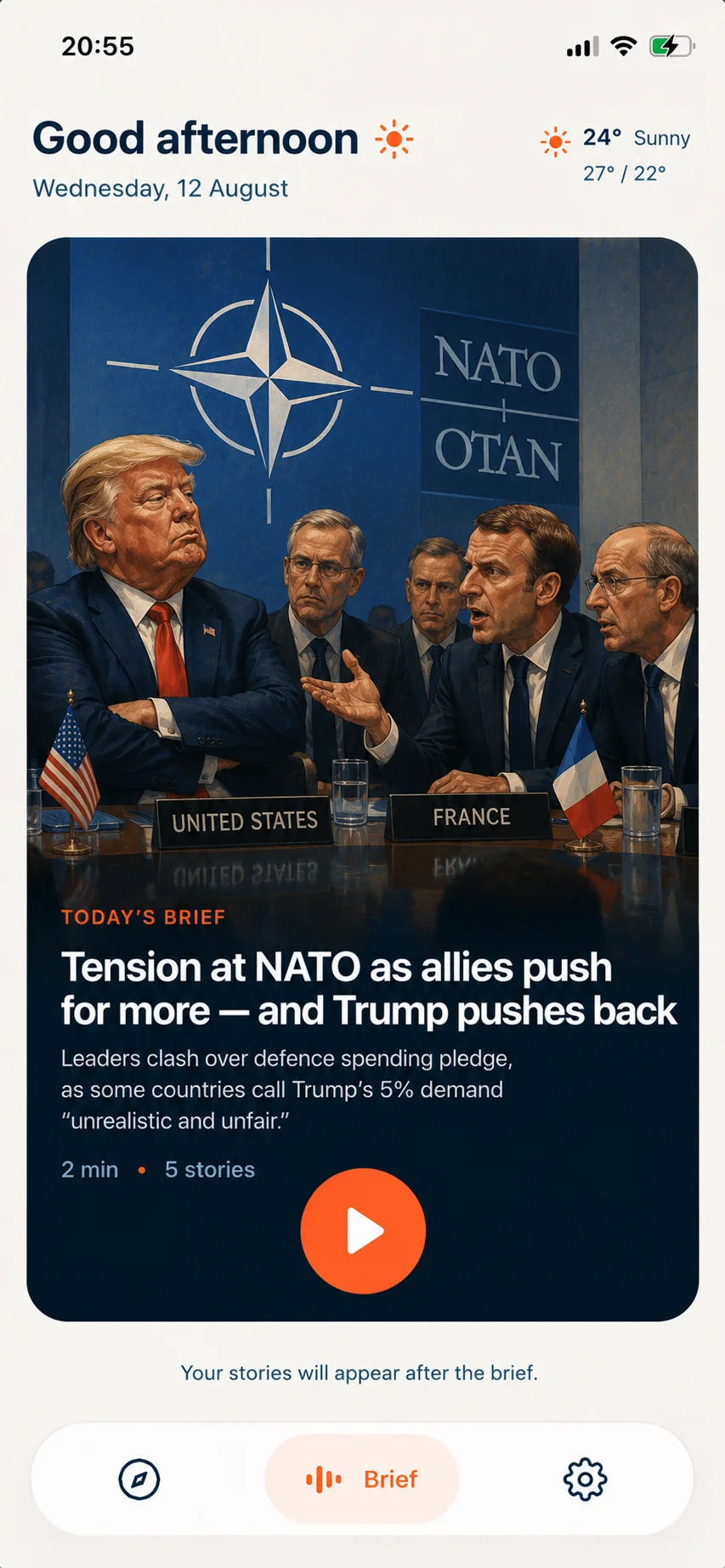
The daily ritual
01
No feed to scroll, no headlines to triage. The brief is already assembled and starts in about two seconds.
02
It plays in the background, on the lock screen, through the commute, the walk, the washing up. Pick up where you left off.
03
When the brief ends, today's stories appear — each with what you heard, and links straight to the newsrooms that reported it.
How it works
Most news audio reads you a single story out loud. Murmur starts a step earlier — with the day itself.
Hundreds of publishers, pulled politely from their public feeds, all morning long.
Twelve articles about one thing become one story. A story is a development in the world, not a publisher's headline.
Each story is reduced to specific factual statements, with the source and attribution attached to every one. The briefing may only be written from the ones that hold up.
A short original explanation — situation, what changed, why it matters — spoken in a warm, unhurried voice. Then it points you at the reporting.
Playing · Story 1 of 4
Apple changes App Store rules
Developers must now disclose AI-generated content inside the app.
The rules take effect for new submissions in September.
‹ Previous
Oil prices rise after tensions
Next ›
Fed signals possible rate cut
Three editions
Each edition asks a different question, and only carries stories that have something new to say since the last one.
Morning
What do I need to know before today begins? The fullest of the three, and the one the ritual is built around.

Midday
Only material developments since this morning. The shortest of the three, and skippable on a quiet day.

Evening
What did the day become? Where the morning oriented you, this is where things landed.
Why it's different
Murmur is an orientation layer for the news, not a replacement for journalism. Everything below follows from that.
Coverage of the same event is grouped and reconciled before a word is written. Where publishers disagree, the disagreement survives — nothing is averaged into false certainty.
Murmur tracks what changed since the last edition. If a story only got rewritten, you won't hear it again. If it genuinely moved, you will — and only the part that moved.
Written for the ear and performed, not pronounced — the tone of a sharp, well-informed friend catching you up. Occasionally dry. Never breathless, never chummy about a hard story.
Every story lists the publishers behind it, with their logos and a direct link to the original article. The depth belongs to them, and Murmur is built to send you there.
The words appear as they're spoken, one sentence at a time, with the full transcript in every story. Never an upsell, never a setting you have to find.
No streaks, no badges, no breaking-news alerts, no infinite scroll. One optional reminder in the morning, scheduled on your phone, off unless you ask for it. That is the entire list.
Your brief
Choose the subjects you follow and how long you want to listen. Murmur builds the brief around them — and the developments you would be embarrassed not to know are in it either way.
Plus any keyword you type. Change it any morning.
Minutes, never a number of stories. A thin news day honestly comes in short rather than padding itself out.
For publishers
Murmur explains that something happened. Everything that makes it worth reading — the evidence, the interviews, the analysis — stays yours, and we point at it.
Feeds and public metadata, an honest user agent with a real contact, conservative per-domain rate limits, and robots rules that fail closed. No paywall, login or CAPTCHA is ever worked around.
Murmur writes its own short explanation from established facts. It does not reproduce your sentences, your phrasing or your article structure, and extracted text is purged on a short retention window.
Your name, logo and canonical link sit on every story you contributed to, and outbound clicks are measured. Logos appear only as attribution — never as artwork, never implying you endorse anything.
Write to support@murmur.news and we will drop your publication to metadata-only or remove it altogether, logo included, the same day.
On every story
Illustrative. Which publishers appear depends entirely on who reported the story.
Access
No advertising, no sponsored stories, no data sold — the subscription is the whole business model, which is what keeps the editorial judgement honest.
Every edition, every story, your own interests, the complete player. Not a sample — the actual product, for a full day.
One subscription unlocks all of it. The App Store shows the current price, and any introductory free trial, in your own currency — so we don't quote a figure here that might not be yours.
There is no premium tier within the subscription. Captions, transcripts, source links, background playback, speed and volume are simply part of the product.
Questions
No. Reading one article aloud is the part Murmur deliberately doesn't do. It gathers everything published about an event, reduces it to the factual statements the reporting actually establishes, and writes a short original explanation from those — which is then performed as audio. The synthesis is the product; the voice is how it reaches you.
Yes, and it's worth being precise about where. Language models extract the factual claims from reporting and write the short spoken explanation. The voice is synthetic. What the model is not allowed to do is invent: briefs are generated only from claims that survived checking against the sources, and automated checks run before anything is published.
Editors can inspect, correct, retract or pause the whole system at any time, and corrections keep a record rather than quietly rewriting history.
No. Murmur has no push notifications at all. The single notification in the product is an optional morning reminder that your brief is ready — you choose the time, your phone schedules it locally, and it is off unless you turn it on. No streaks, no re-engagement nudges, no urgency.
Yes. Captions are on by default and follow the narration a sentence at a time, and every story carries the full text of what was said, along with its sources. Listening is the point, but reading is never a downgrade path you have to pay for.
No. There's no signup, no password and no email address required to use the app. Your preferences are held against an anonymous identity created on first launch. Full accounts — and with them, syncing across devices — come later.
Very little, by design. No name, no email, no precise location, no cross-site identifiers, no advertising profile. Your chosen topics and keywords stay out of analytics and out of logs entirely. The privacy policy lists everything that is collected, item by item, and what each thing is for.
After iPhone. Murmur is iOS-first so the daily listening habit can be tested properly before it widens, but the app is written so Android — and desktop listening in the browser — follow without a rewrite. Write to support@murmur.news if you'd like to hear when it lands.
Email support@murmur.news and we'll act on it the same day — either dropping your publication to metadata-only, or removing it and its logo completely. No forms, no negotiation.
Now on iPhone
Murmur is live on the App Store. Download it tonight, pick your topics, and your first eight-minute briefing is waiting when you wake up.